

Building The Frontier Investment House
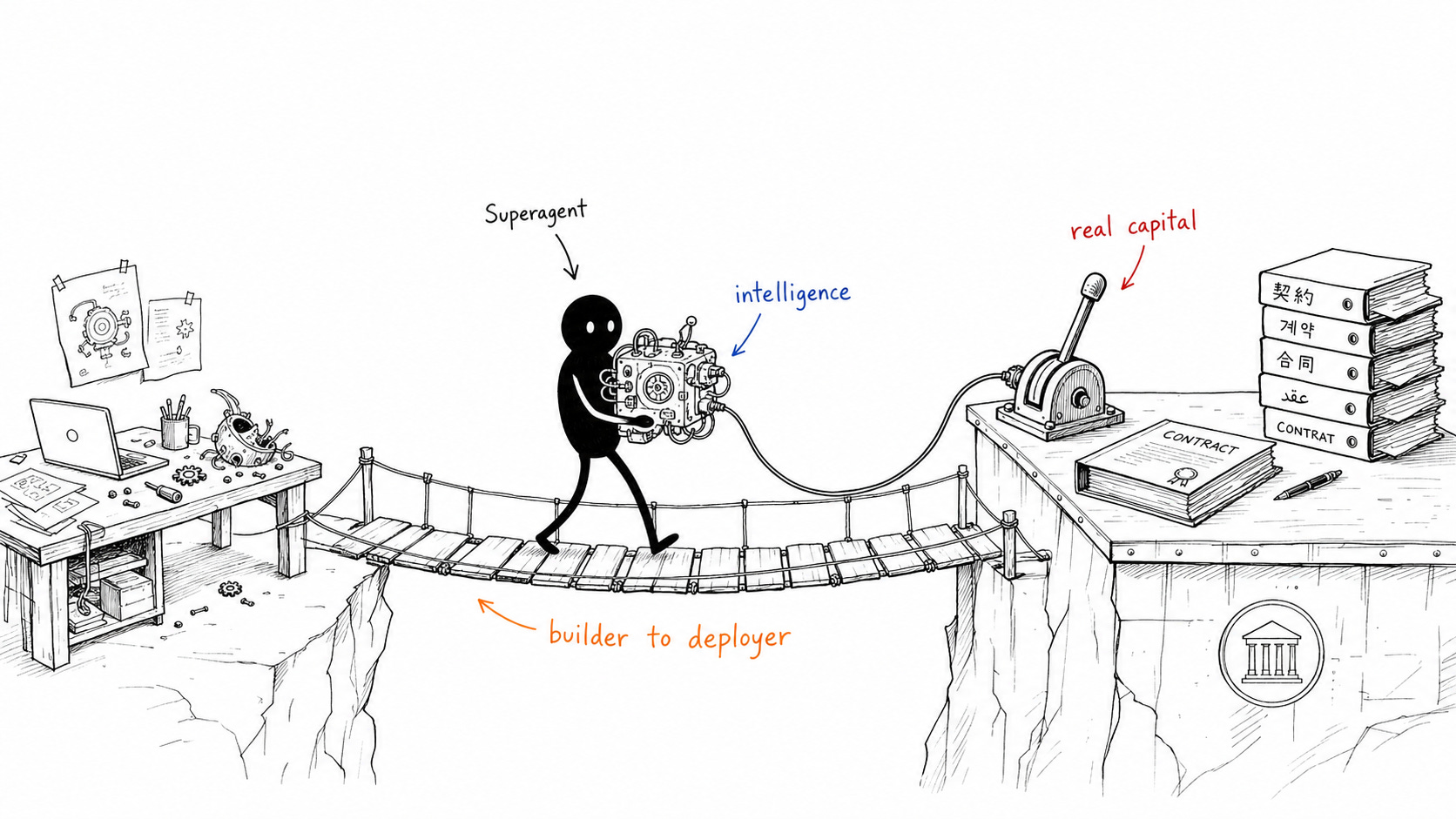
Season 2 is about deploying the intelligence where real capital is at stake.

For the last two years, I have been building a deep-tech startup in federated learning, doing what founders do when the ambition is larger than the team.
I moved from system architecture to operations, marketing, and go-to-market.
By the end of 2025, we were fundraising and could not afford a full-time marketing hire. But maintaining consistent social presence was critical.
So I asked a simple question:
How much of this marketing can I automate with AI?
The first prototype was scrappy (done with crew.ai). By the end of January 2026 (thanks to OpenClaw), I had built an operating system of agents that could scout, research, write, edit, design visuals, and handle parts of outreach and follow-up.
A budget constraint had pushed me into the rabbit hole of agentic systems.
I have barely looked up since.
My background is in computer science, and I spent almost a decade in blockchain as a solution architect and researcher. Systems thinking, architectures, incentives, dependencies, failure modes has always been my edge.
But I never saw myself as a professional coder.
For most of my career, there was a painful distance between seeing a system and being able to build it. AI collapsed that distance.
Over the past six months, I have spent more than 2,000 hours building with agentic coding tools. Suddenly, I could turn the systems in my head into working software at almost the speed I could think.
It felt like a superpower, true leverage.
That was Season 1.
This summer, I took on a new responsibility at Scipio to transform an investment holding company into an AI-native investment house.
The mandate is simple:
How do you turn judgment buried in a few people’s heads into a system that helps GPs make unconventional bets AND hold them with conviction?
and
How can we extend that capability across the portfolio?
Season 2 is about deploying the intelligence where real capital is at stake.
The operating system of an investment house
Center question: What does an investment house actually run on?
An investment house runs on two things:
Information
Judgment about that information.
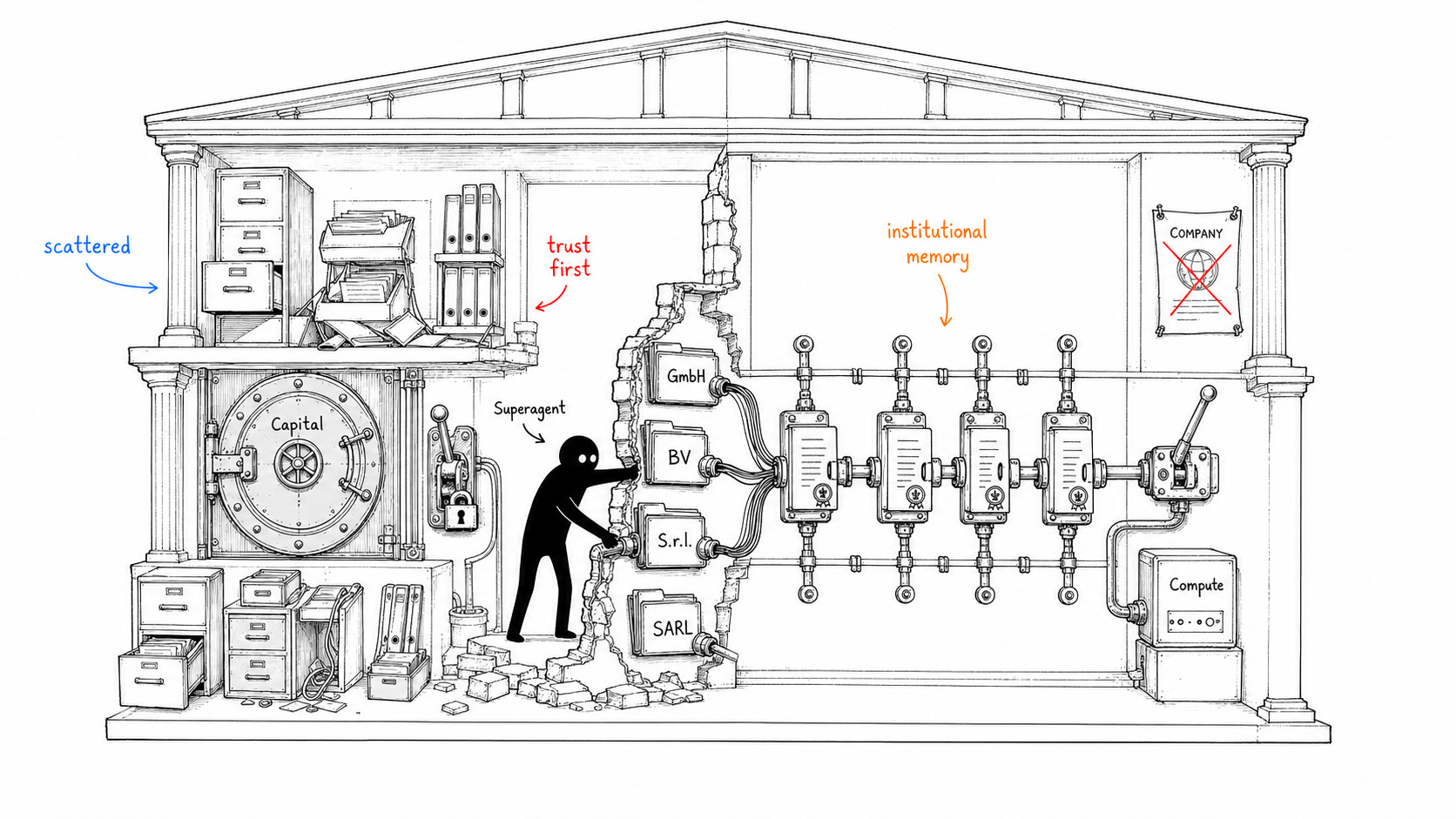
The information is scattered across documents, languages, legal systems, inboxes, and people’s memories.
The judgment is even harder to capture. It lives in the patterns an investor or the team have learned to trust, the risks they instinctively question, and the core principles that fallback to.
The opportunity is not merely to automate the work. This is by-product.
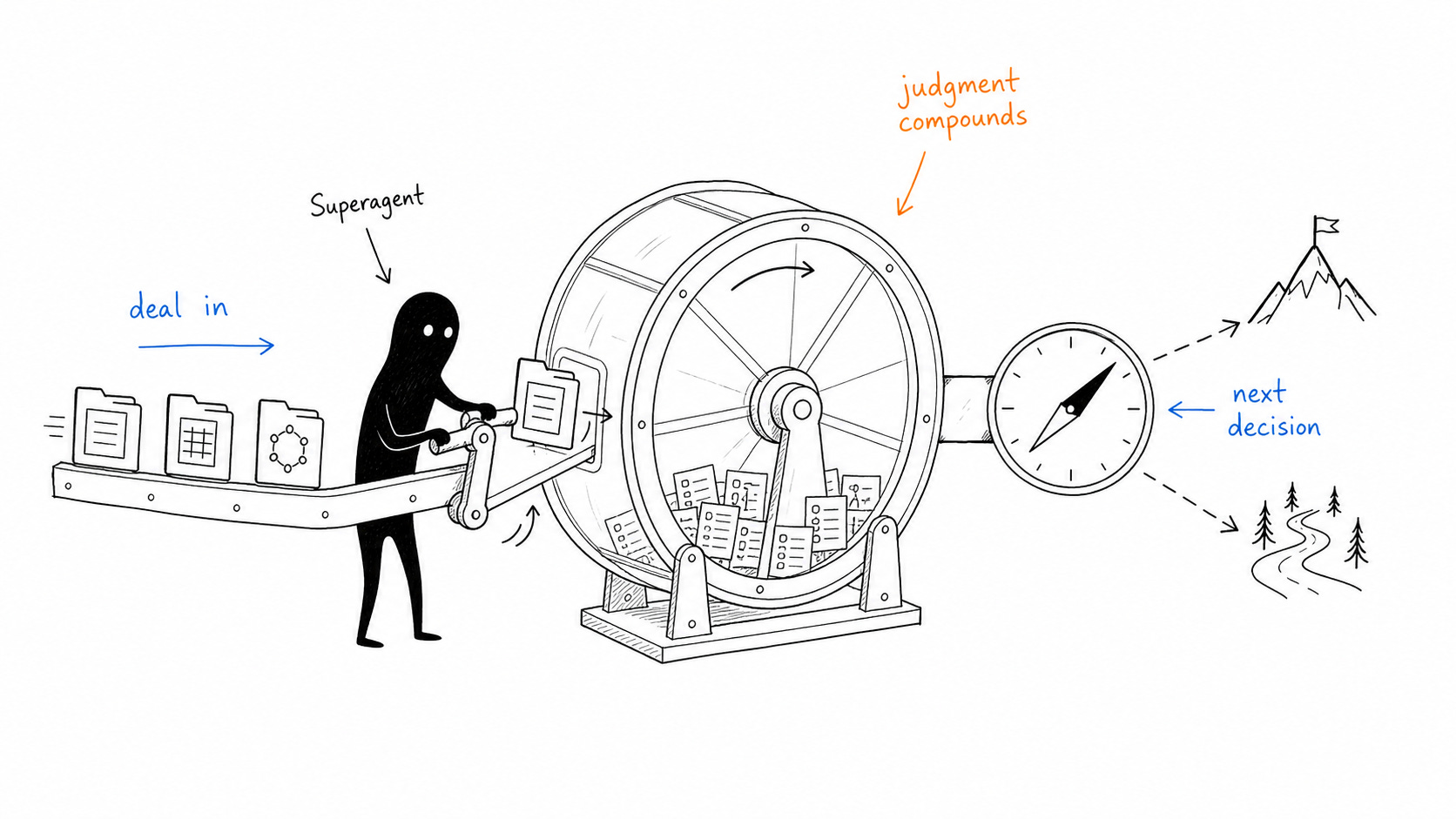
It is to give that judgment - a memory, a system that preserves it, challenges it, and makes it stronger over time.
Imagine every document entering the house becoming part of a durable, queryable institutional memory. Every deal becoming a leverage for the next one.
Knowledge stops disappearing when someone leaves.
Judgment begins to compound.
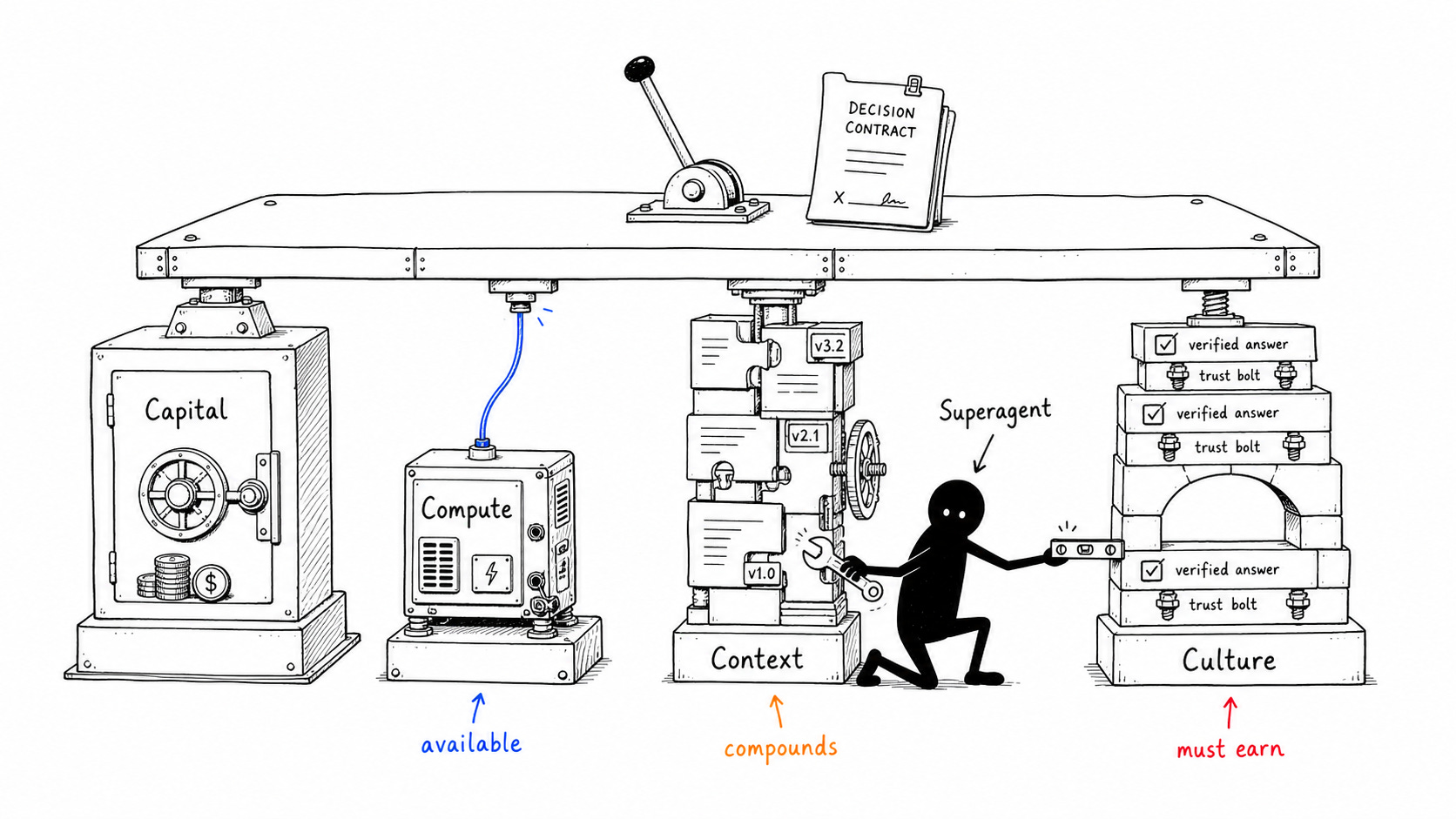
Getting there requires four things:
Capital. Compute. Context. Culture.
The team already understands the Capital in its bones.
The other three are where the real work begins.
Compute
Frontier models are getting cheaper, faster, and more capable. That means the model itself is not the edge.
The edge is what you allow it to see, what you teach it to remember, and how the team
leverages it.
Compute gives you generic intelligence on demand.
It does not give you institutional intelligence.
For that, you need context.
Context
This is where the clean vision hit the messy reality.
Context is the hardest technical problem, and the one we have to get right.
The work is not simply giving a model access to documents. It is turning the house’s fragmented knowledge into something the system can retrieve, interpret, and build upon without losing meaning.
There are signed agreements, amended agreements, old models, new models, disputed numbers, missing context, and decisions that were never written down.
The system must know what is authoritative, what is outdated, what contradicts what, and when it does not know enough to answer.
That is context engineering.
First step is to get ONE SOURCE OF TRUTH.
The feedback loop around that context may be the only real AI moat an investment house can build.
Models are available to everyone.
The house’s memory is not.
Its decisions are not.
Its pattern of being right, and the record of where it was wrong.
Capture that loop, and every deal teaches the system how the house thinks. Over time, it does more than retrieve information. It begins to surface patterns the team can turn into alpha.
But getting there is brutally difficult.
The knowledge is scattered across languages, jurisdictions, document types, inboxes, and years of history. The same company appears under different names. The same metric appears with different values. A decisive clause sits inside an appendix to a shareholder agreement no one remembers exists.
The system rarely fails with the courtesy of an error message.
Sometimes it returns nothing.
Sometimes it retrieves the wrong EBITDA.
Most dangerously, it gives a confident answer supported by evidence that looks right.
The words can translate while the meaning does not.
A German GmbH and a Dutch BV might both become “a company” in English. Treat them as interchangeable, and the system can reach the wrong conclusion about governance, liability, or control.
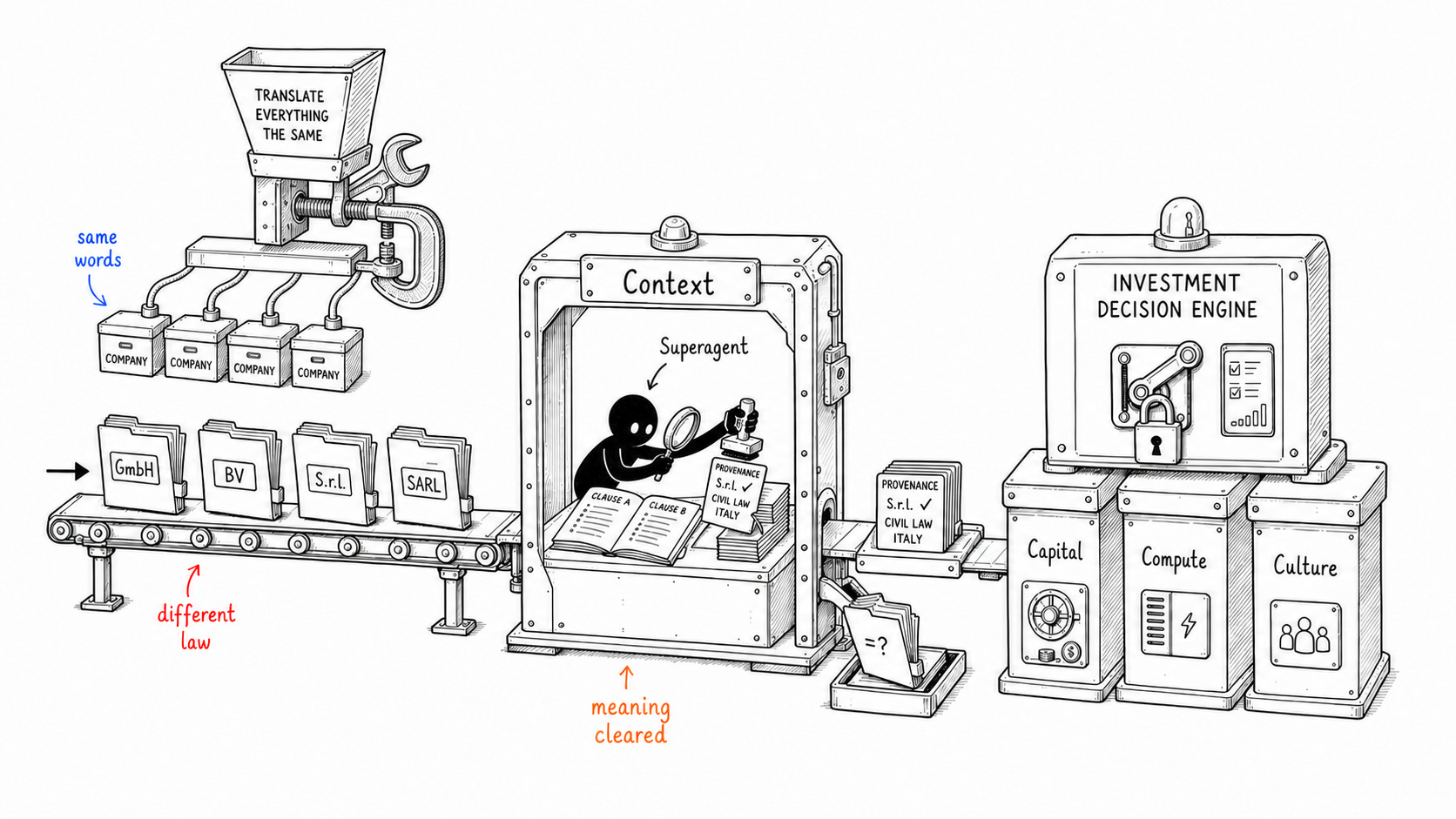
Multilingual legal documents are not merely a retrieval problem.
They are a meaning problem.
Probably, the most critical to get it right.
Culture
Even if we solve all of that, the system can still fail.
The real adoption problem is trust.
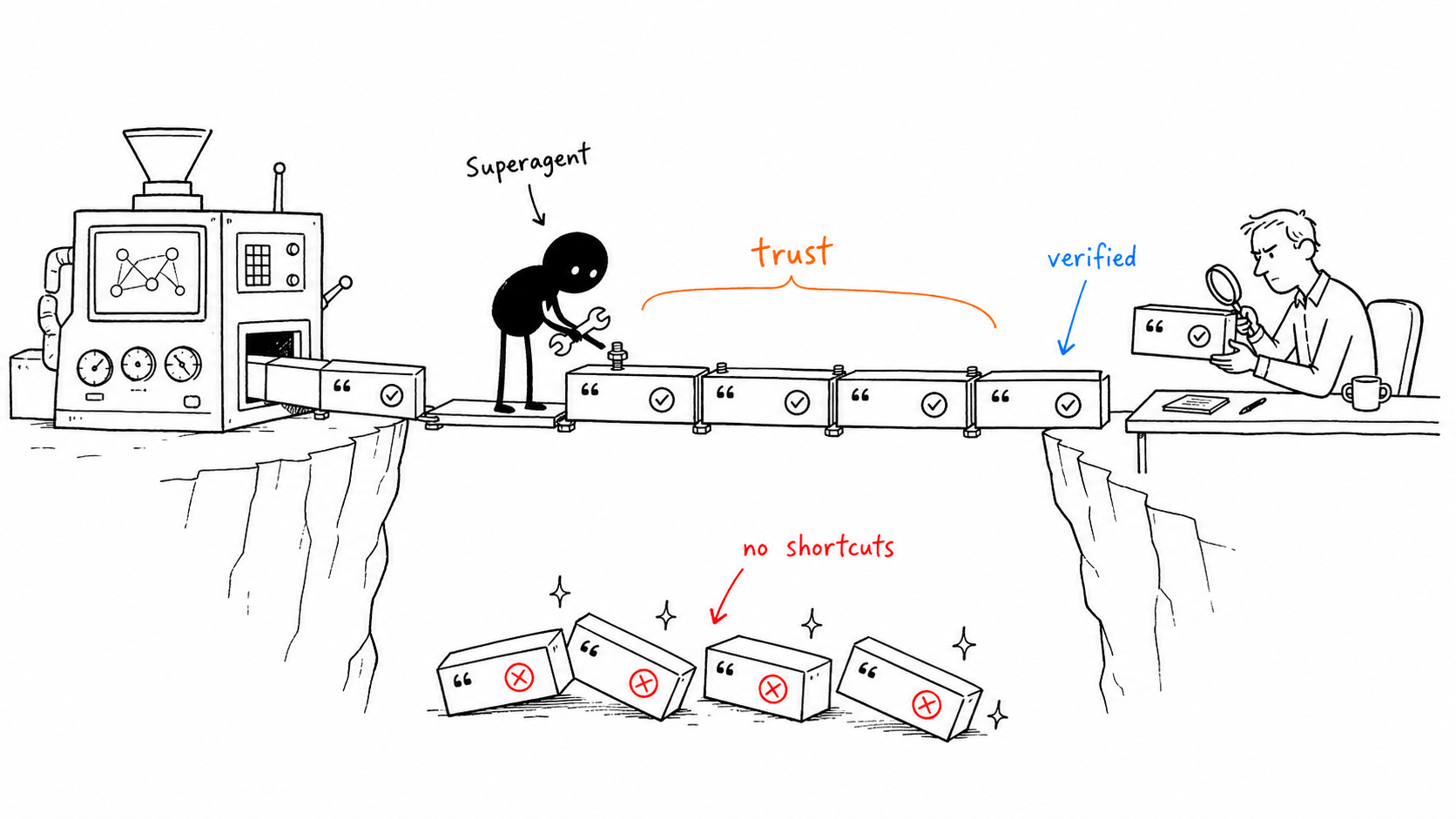
You can buy compute. You can engineer context. But you cannot install trust.
No launch announcement changes that. No polished demo changes that. Calling the system “AI-native” certainly does not change that.
Trust must be earned, one verified answer at a time.
People need to see where the answer came from. They need to challenge it. They need to watch it admit uncertainty. They need to know that when it fails, the failure makes the system better.
That is how a tool becomes infrastructure.
Culture dictates whether intelligence becomes institutional or dies as another pilot everyone praised and nobody used.
What comes next
This is what I will be writing about in Season 2.
I will go inside the process of building an AI-native investment house:
How we create institutional memory from fragmented information. How we preserve meaning across languages and legal systems. How we resolve contradictory truths without hiding uncertainty. How we evaluate systems that fail silently. How investor feedback sharpens every deal that follows. And how we earn trust without pretending the technology is infallible.
I will write about the architecture.
More importantly, I will write about where the architecture breaks.
The missing document. The wrong EBITDA. The translation that preserved the words but destroyed the meaning. The confident answer no one should have trusted. The human habit no workflow could change overnight.
One system. One failure. One repair at a time.
The ambition is not to make investment teams faster.
Speed is the byproduct.
The ambition is to give judgment memory. To preserve it, challenge it, and compound it across every decision that follows.
Capital is what the house deploys.
Compute is what it can buy.
Context is what it must build. (The only moat)
Culture is what it must earn.
Get all four right, and every deal makes the next decision more intelligent.
That is the frontier investment house.
And that is what I am building next…